
Decaying Senses
Thoughts on losing our instincts & self-defense

I recently tried grappling and Brazilian Jiu-Jitsu.
I found a window of opportunity to reopen a chest of memories and to confront all that had been left unused and ignored since I was a young girl. Had I known how much I would enjoy pinning people down with full resistance on the mat to submission, I might have followed a completely different life path. But this is life. It took me a long while to come out of my shell. This wasn’t my first introduction to martial arts. I grew up around people who valued it deeply, and I had some exposure myself, dabbling in Taekwondo, Aikido, and a few self-defence classes back home. But I never had an early window into grappling.
There is something so primal in it. I don’t see who is in front of me, a man or a woman, but only an obstacle, a kind of door. My pure survival depends on it, and I must master my body and mind as one whole being.
There is something deeply spiritual and present in this practice too, where the mastery of senses and breath becomes the only way out. My sense of time disappears, and afterwards I feel liberated from all my troubles and worries.
I must also say that practicing vigorous vinyasa and ashtanga yoga has given me the stamina and confidence to endure these classes. If there is anyone out there who still thinks yoga is just for relaxing, they have no idea what they are talking about.
I’ve seen very fit-looking men and women shaking and panting with sweat in Stewart Gilchrist’s 90-minute Yogasana classes on Sundays and Mondays (नमो स्टेवर्टगुरवे — namo Stewart-gurave). For the very first time in my life, I built strength through yoga practice. Not through weightlifting or cardio — but through yoga.
This wasn’t my first introduction to martial arts. My father practised it for many years and often spoke about how much it shaped his outlook on life. I had some experience too, dabbling in Taekwondo, Aikido, and a few self-defence classes back home. But I never had an early window into grappling.
I notice how certain temperaments, especially those inclined toward suppressed anger or internal tension, find powerful release and discipline through martial arts and self-defence. It teaches restraint, structure, and mastery over reaction. I often think this inclination might connect to ancestry as well, since our family roots trace back to regions like Makhachkala and Abkhazia, places defined by endurance, strength, and the need to survive. Perhaps if I had discovered grappling earlier, it might have helped me channel that intensity differently. Unfortunately, when I was growing up, Istanbul or Ankara did not have established institutions for grappling or Brazilian Jiu-Jitsu. And in places like Dagestan, those environments were, and still are, heavily male dominated, leaving little room for women to take part.

When I look back at many of my conversations with my father, there is a distinctive theme: the need to stay alert, to be aware of one’s surroundings, to walk without distractions, and to know how to respond in moments of danger. I used to think these warnings were repetitive and unnecessarily anxious, but over the years, they have started to feel natural, even necessary.
Such advice often comes from lived experience. People who have encountered danger tend to speak from survival, though not always in real time. There is a certain pride in having faced it and made it out unharmed, as if part of them unconsciously draws those moments closer, testing fate again and again.
Stories of sudden threats are not rare. A man pretending to offer help turns out to be armed. Someone is attacked from behind during what should have been a calm morning walk. Groups target an individual for no reason other than a look, a word, or a gesture.
Turkey is particularly riddled with incidents like these, often rooted in gang or looks-related violence. The reasons go beyond race; sometimes it is simply because you looked “interesting” to someone, or because you did not respond to a provocation. That alone might be enough for them to come after you.
I now find myself imagining similar scenarios in London, such as common phone thefts or random attacks by people struggling with severe mental instability, released back onto the streets despite multiple prior offences. Knife crimes in particular weigh on my mind. I often think about how I would react, how I would get out of such a situation. The rule of survival, I have learned, is simple: you run when you see a knife.
My feed is full of endless examples, mostly from the US but also many from Turkey. Certain big cities seem to have become breeding grounds for recurring acts of violence. We like to believe it is our natural right to feel safe in the places we live, and rightfully so. But we are not there yet, not in this reality, not in many countries.
As I went deeper into this concerning and rapidly growing problem, I felt the need to analyse the murder of Ukrainian refugee Iryna Zarutska — particularly watching the timeline and action of the attack closely. May she rest in peace.
The fact that Iryna did not lose her life in her own war-riddled country, but instead was senselessly attacked by a stranger on public transport in a country she took refuge in, made me obsess over whether this could have been avoided. From there, I found myself watching the video numerous times, trying to see exactly what happened.
The very first question:
What is the one thing in common these strangers have sitting in this portion of the train?
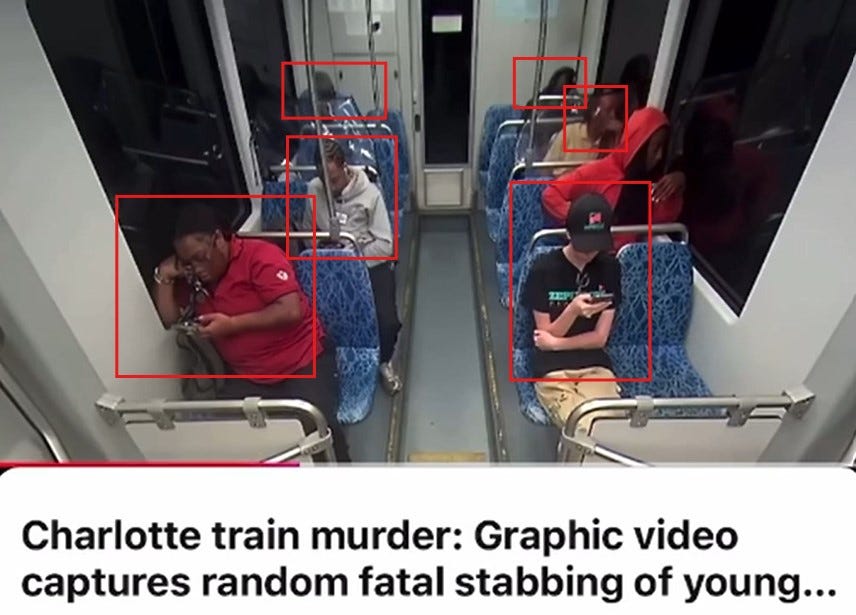
They are all on their phones.
Most probably, all these individuals had noise-cancelling headphones on as well.
We are all like this in public transport nowadays, and not only during transport. Walking, sitting in a café, or spending time in a park, we carry the same habits with us. To blame Iryna for listening to her music or looking at her phone is of course senseless. Still, our collective habit and practice of detaching ourselves from public spaces only makes us more and more vulnerable to those rare but deadly situations.
I can’t blame us for it completely. Nobody is happy to spend minutes or hours commuting on a packed train surrounded by miserable faces. Of course we want to bury our faces in our phones with music. But I feel we must find a way in between — to stay alert while still minding our own business.
Another thing that caught my attention was how slow and dismissive the passengers’ reactions were. It took those nearby a few precious seconds to even realise what had happened. Almost all of them were on their phones, and most likely wearing headphones again. Had anyone been in a more alert state, perhaps the lady sitting to her right, she might have assisted Iryna faster, or at least alerted everyone around her to what was going on. An individual like that could easily have attacked other passengers on the train.
The continuous footage of the attacker walking away, leaving blood drizzling everywhere, with no one able to react or do anything, is absolutely gut-wrenching. I unfortunately saw the full edited video of Iryna fainting into the foot space, and within those seconds, nobody approaches her. Everyone’s senses are shut down. I get the fear, I get the shock. But when did we become so scared, even after the attacker had already walked off?
Of course, I am not saying people should risk their lives completely. There are endless stories of individuals losing their lives or even going to jail because they tried to help. But this does not mean there are no other ways to assist, even if the impact of it may be small.
Since the footage available online is naturally edited due to its graphic nature, we cannot see exactly how and when Iryna was approached, or whether anyone tried to assist her at all.
If you watch the video (graphic warning), you are likely to realise that Iryna had almost no chance of surviving, even if she hadn’t been wearing headphones and looking down at her phone. The attack comes completely unexpected; she is sitting right in front of a stranger, completely unaware of what may come.
Without headphones and a phone, perhaps she could have sensed the quick movement and, with a bit of reflex, shifted. But this probability is still not enough, especially considering the size of the attacker and the limited space.
This leaves us with two areas to consider:
Instincts: reflexes and observation skills
Incarceration of permanently unstable criminals
Instincts & Observation
Starting with instincts and observation, I must return to our phone-use habits. The distracting patterns of apps and social media play a huge role. We are completely immersed in whatever we are watching or listening to, while at the same time stuck in our heads, analysing and processing multiple layers of content. This doesn’t leave room for our hearing and other senses to stay alert to what is happening around us, such as:
Who is sitting next to me or behind me?
How are their movements feeling beside me?
Who just walked past? How many?
What is the body language of the person nearby?
How is their walking rhythm?
What is their rough proximity? Do I have escape space?
Where is their gaze?
Can I see the exit or other routes from where I’m sitting?
As humans, we have a natural ability to sense and make use of these pathways without much planning, especially in dangerous situations. However, the vast use of personal phones, apps, games, and digital content in public spaces is sanding down our base instincts — the very instincts designed to protect us.
I cannot give an exact, tangible example of a “gut feeling” in an unfamiliar environment, but think of it this way: a stranger often gives off cues, whether in appearance, tone, or mannerisms. Being open to your gut and instincts in those milliseconds can help you act ahead of time and give you an advantage. Such as choosing to sit or stand somewhere different, or not going through a particular street, for example.
This is exactly why a basic form of martial arts, self-defence, and street awareness must become part of our lives. I am not saying we should all go Spartan and live as if we’re back in the Roman Empire. But we must not forget that we still live in a wild world, and technology, governments, or modernity do not guarantee safety. It is, in fact, ignorant to think that people should not have to learn to defend themselves. Quite the opposite. The instinct of survival and self-protection is imprinted in our blood and genes, and we are defying our very primal nature by skipping this most basic need.
And I must say: as women, we must learn how to protect ourselves. This is why I find fundamental grappling lessons so helpful. I am grateful to have a father who always pushed me to learn self-defence and ingrained in me the habit of being aware of my surroundings. Grappling, wrestling, and other martial arts are not reserved for men. You would be surprised at the sheer power of a woman’s thighs clutching your neck. It is fascinating.
Incarceration
The latter part, unfortunately, is out of our hands.
The attacker, Decarlos Brown Jr., comes from a crime-riddled family along with severe mental health issues. Unfortunately, this individual had reached a point where rehabilitation with our current incarceration methods is nearly impossible. Even if we had a holistic breakthrough in our approach, it would likely be too costly to create and sustain long-term programs capable of healing individuals shaped by destructive family backgrounds and substance abuse. It will take us years to establish such a system. I am still hopeful.
It is a very sensitive subject. Given the current state of things, the only possible option seems to be for mayors and lawmakers to leave no space for repeat offenders to be released. I genuinely try to imagine a long-term approach — but as a society, we would need to jump through enormous hoops to establish truly effective healing practices. Dry hospitalisation and medication alone cannot heal these individuals. Most of them are already beyond that possibility.
Prisons? I am not sure if I am knowledgeable enough to talk about what really happens inside, but clearly things are not working at their best capacity. When it comes to actually being able to “recycle” troubled individuals back into society — or permanently keep them there if necessary — we can’t seem to get it right.
Final thoughts
To finalise my point for the ladies: don’t be afraid to grapple, to wrestle, to sweat on the mat.
I had silly thoughts in the past, “eww, I don’t want to touch strangers’ feet or pick up a man’s arm hairs between my toes.” But once you are on the mat fighting for yourself, you absolutely don’t care about the smell of feet in the dojo or how your hair looks. You take your bruises home with pride and suffer through the soreness with dignity. (My left inner thigh and lower abdominals are done with me at this moment) Eventually, you build endurance.
There is nothing that makes you more confident than knowing you can stand up for yourself (and for others) physically and mentally. Martial arts — and I would also say yoga — teach these in tandem.
Even if only one woman on Substack reads this and decides to go into grappling or any self-defence class, then this post will have reached its purpose.
Stay with love and strength, inside and out.
Your post has been read and appreciated by this 68-year-old man in Western New York. Arthritis has left me in no condition to defend myself from a physical assault. I’m able to drive anywhere I need to go and I have a tag that entitles me to park in a handicap spot near my destination. I do keep a fire iron tucked under the dash on the passenger side. It’s about 60cm long and very heavy with a pair of nasty hooks on the end. It’s hard to see but very easy to reach. I pray that I never have to use it. Your article is full of good advice for any person who needs to walk or use public transportation. The video—I skipped that over because I knew it would upset me. But I read the text with fascination and a little apprehension because I feared that you might be going to recount some horrible thing that happened to you. I’m glad that was not the case. Be strong, stay safe, be well. I’ll Restack this article with the highest recommendation and I hope lots of people read and take it to heart!